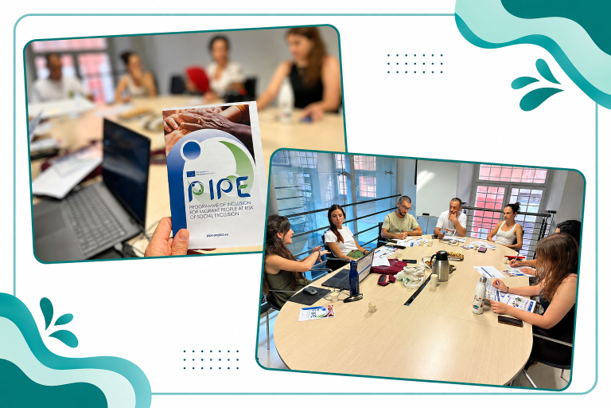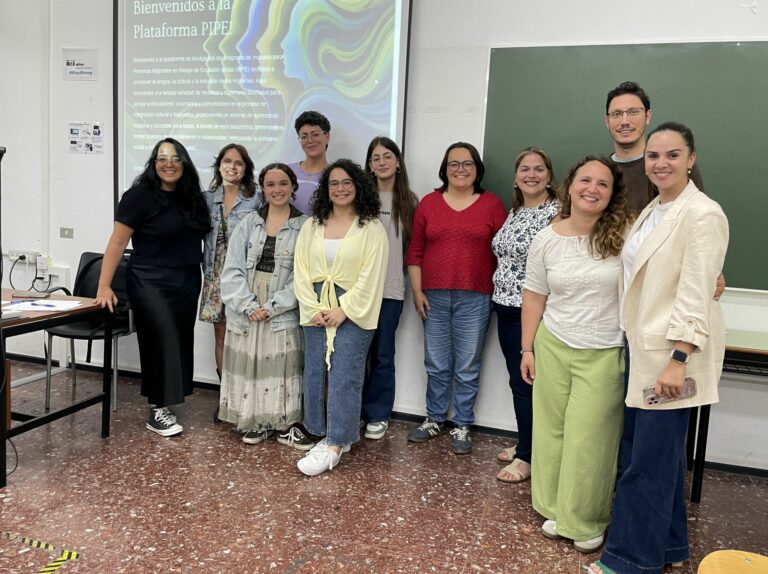


The work developed within PIPE is going beyond project activities and contributing to a wider academic discussion on migration, education, hospitality and citizenship.
Researchers from the University of La Laguna, one of the PIPE partners, have developed a line of research closely connected to the themes and experiences explored within the project. Over the last two years, this work has resulted in three academic publications by Andrés González Novoa, María Lourdes C. González Luís, Pedro Perera Méndez and María Daniela Martín Hurtado.
The first, “Pedagogy of Hospitality: Critical Reflection on Teaching Language to Migrants”, was published in Education Sciences in March 2025. The article is directly linked to the researchers’ participation in PIPE and reflects on language teaching not simply as a tool for integration, but as an opportunity to promote dialogue, mutual recognition and intercultural coexistence.
This reflection continued with “A Pedagogy of Hospitality to Imagine Migrant Citizenship and an Ethics of Mestizaje”, published in the International Journal of Political Thought. The paper explicitly refers to the collaboration between the European universities participating in PIPE and the PEDACRI-ULL critical pedagogies research team.
At the centre of this work is the idea of a “pedagogy of hospitality”: an approach that invites us to rethink integration as a two-way process. People arriving in a new country do not simply adapt to an existing culture; they also bring their own experiences, knowledge, memories and perspectives. Education can therefore become a space for dialogue and exchange, where different ways of understanding the world meet and contribute to building more inclusive communities.
The research has continued to evolve. In 2026, the same four authors published “Identity development through pedagogy of hospitality: a conceptual framework for language teaching in intercultural education” in the Journal for Multicultural Education. The article moves from reflection towards a more structured conceptual framework for language education in intercultural contexts, identifying pedagogical principles and a three-phase model based on welcome and recognition, pedagogical questioning and knowledge dialogue.
Together, these publications show how ideas and experiences developed through PIPE can continue to grow beyond individual project activities. What began as work on tools, approaches and competences for migrants and the professionals supporting them has also become an opportunity for research, critical reflection and exchange with the wider academic community.
This is an important part of PIPE’s wider impact: creating resources and opportunities within the project, while also encouraging partners to bring its experiences into new contexts and contribute to an ongoing conversation about migration, education and social inclusion.
Explore the publications
Pedagogy of Hospitality: Critical Reflection on Teaching Language to Migrants
Andrés González Novoa, María Lourdes C. González Luís, Pedro Perera Méndez and María Daniela Martín Hurtado
Education Sciences, 15(4), 437 (2025)
https://doi.org/10.3390/educsci15040437
A Pedagogy of Hospitality to Imagine Migrant Citizenship and an Ethics of Mestizaje
Andrés González Novoa, María Lourdes C. González Luís, Pedro Perera Méndez and María Daniela Martín Hurtado
International Journal of Political Thought, Vol. 20, pp. 151–174 (2025)
https://doi.org/10.46661/revintpensampolit.12598
Identity development through pedagogy of hospitality: a conceptual framework for language teaching in intercultural education
Andrés González Novoa, María Lourdes C. González Luís, Pedro Perera Méndez and María Daniela Martín Hurtado
Journal for Multicultural Education, 20(3), pp. 419–436 (2026)
https://doi.org/10.1108/JME-09-2025-0234