
In a European context marked by increasing migration flows and profound socio-economic transformations, analysis and research are essential tools for designing concrete solutions. Within the PIPE project, these activities form the foundation for the development of practical tools, training pathways and platforms that effectively support migrant integration.
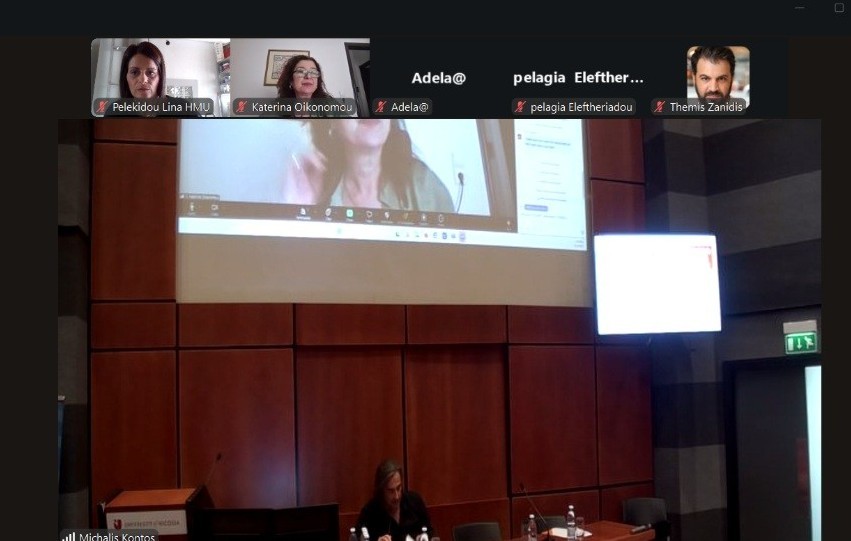
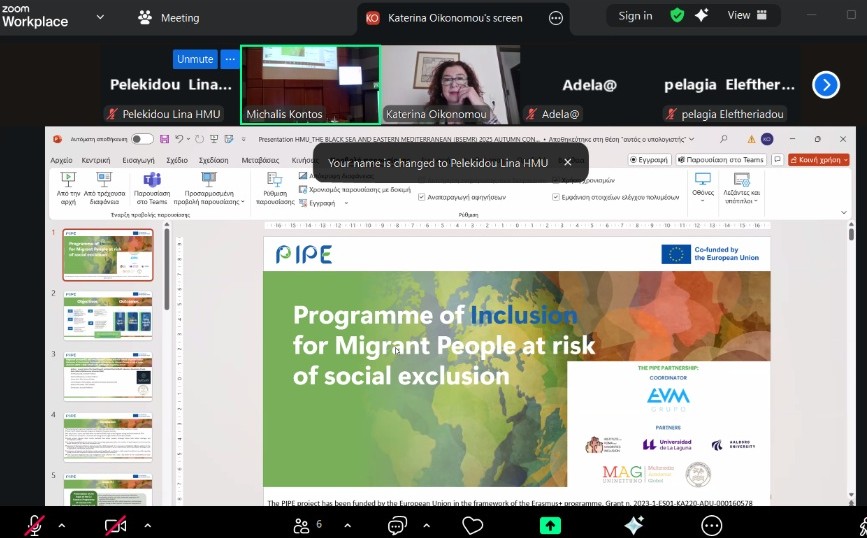
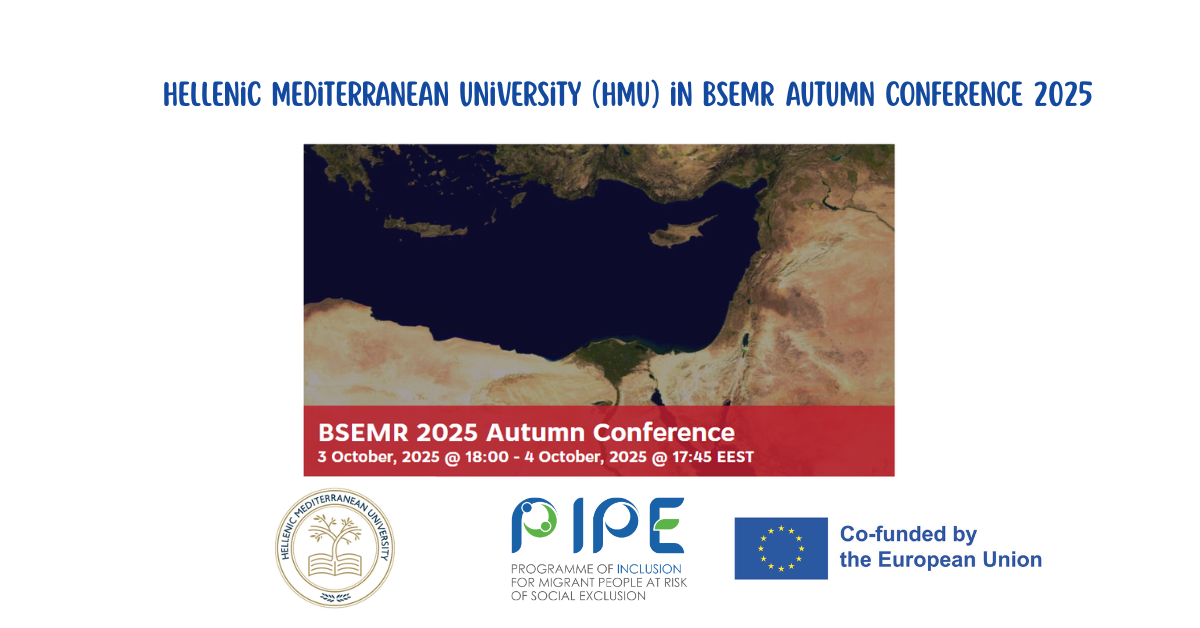
Among the research activities carried out, a particularly relevant contribution was presented by the Hellenic Mediterranean University (HMU) at the BSEMR 2025 Autumn Conference, held at the University of Nicosia (Cyprus).
The conference, titled “The International Order in Question: Regional Security and Prosperity in Times of Global Flux and Disarray”, brought together scholars and experts to discuss key geopolitical and socio-economic challenges in the Black Sea and Eastern Mediterranean region.
HMU’s contribution: the PIPE project
During the session on 4 October 2025, the HMU team presented:
“Regional prosperity and employment integration in times of global influx”
The presentation showcased the results of the European project PIPE – Programme of Inclusion for Migrant People at Risk of Social Exclusion (Erasmus+, 2023-1-ES01-KA220-ADU-000160578), with a specific focus on the Greek context.
Migration and labour market: evidence from the research
The research highlights a complex European landscape:
- over 5 million Ukrainian refugees currently in Europe
- approximately 80,000 new arrivals in the first eight months of 2025 in countries such as Greece, Italy, Cyprus and Malta
- in Greece, more than 62,000 arrivals in 2024 and around 30,000 in the first months of 2025
At the same time:
- many migrants remain excluded from the labour market
- Europe is facing labour shortages and demographic challenges
- sectors such as agriculture, construction and tourism show a strong demand for workers
In this context, labour market integration emerges as a strategic lever for economic growth and social sustainability.
Methodology and areas of analysis
The HMU contribution is based on desk research (2019–2024) analysing 41 sources, including studies, reports and statistical data.
The analysis focused on:
- soft skills
- cultural awareness
- mentoring programmes
- national policies and priorities for employment integration
Barriers and good practices
The research identified several recurring challenges:
Barriers
- lack of soft skills
- linguistic and cultural barriers
- limited access to professional networks
- mismatch between skills and labour market needs
Good practices
- mentoring programmes
- practical, work-oriented training approaches
- participatory and learner-centred models
- support networks within migrant communities
From research to concrete tools
A key strength of the PIPE project lies in the direct link between analysis and implementation.
Research results are used to:
- develop targeted training pathways
- design practical tools for employability
- build mentoring and support networks
- promote the exchange of good practices among migrant communities
This approach ensures that data and evidence are translated into concrete solutions with a real impact on integration processes.
Conference context
HMU’s contribution was part of a broader, multidisciplinary programme addressing topics such as:
- international law and global crises
- security and cybersecurity
- misinformation and migration
- geopolitical dynamics in the Mediterranean
Conclusions
HMU’s participation in the BSEMR 2025 highlights the central role of applied research in shaping effective integration strategies.
The PIPE project demonstrates that:
- analysing national contexts is essential
- training must be practical and employment-oriented
- support networks play a key role in successful integration
In an evolving global context, initiatives like this contribute to building more inclusive and sustainable societies.