
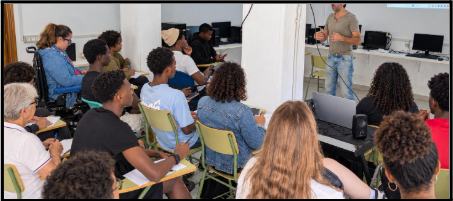
A hands-on workshop in Añaza turns direct user experience into concrete recommendations for the final improvement cycle of the Erasmus+ PIPE project.
A digital guide proves its worth when the people it was created for can put it to the test.
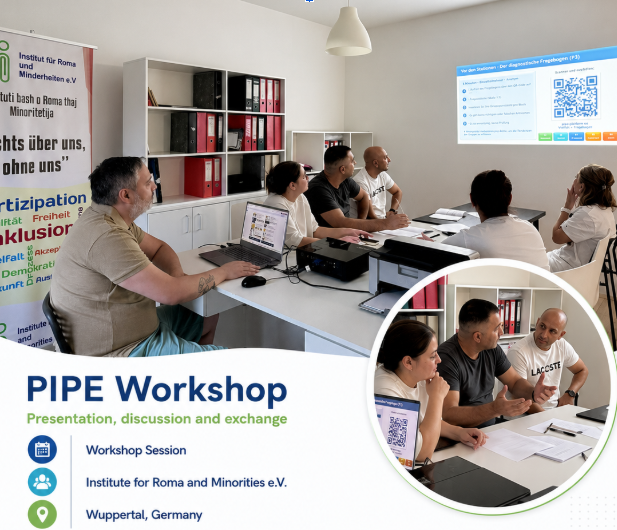
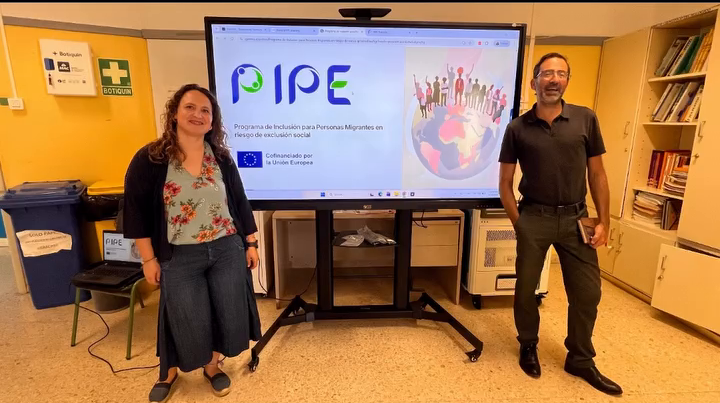
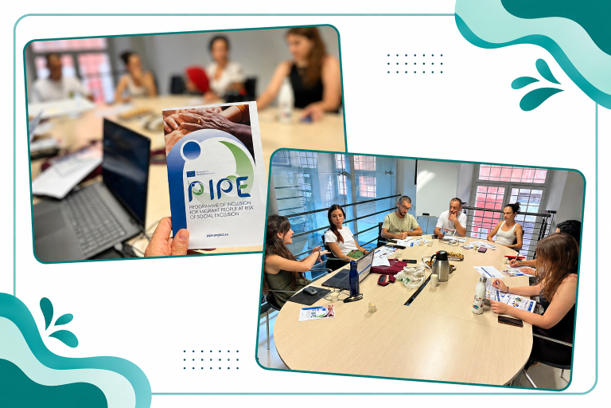
That was the purpose of the PIPE Migrant Guide workshop held in Añaza, Tenerife, on 20 October 2026, where ten adult migrants explored the app on their own devices, navigated practical modules, tried interactive quizzes and word mini-games, and shared first-hand feedback on what helps, what confuses and what still needs to improve.
The session was co-organised by Universidad de La Laguna (ULL) and EVM Group, in collaboration with Fundación Canaria El Buen Samaritano, as part of Work Package 4 of the Erasmus+ PIPE project. Participants worked in Spanish, English, French and Arabic, moving from a guided introduction to independent exploration, group reflection and an anonymous post-workshop evaluation.
Strong acceptance and useful criticism
The response was very positive. Participants rated both the clarity of the content and its relevance to their situation at 4.2 out of 5. The facilitator’s introduction scored 4.8 out of 5, overall workshop satisfaction reached 4.5 out of 5, and all ten participants said they would recommend the PIPE Migrant Guide to other migrants. At the same time, the workshop produced the kind of criticism that user testing is meant to uncover. Several participants reported slow performance and uneven language reliability. French and Arabic presented difficulties for some users, while another participant observed that languages became mixed during navigation.
“It would be good if it could be heard in our languages; many of us arrive unable to read or write.”
Accessibility as a condition for inclusion
The request for audio and read-aloud support was one of the most significant findings of the session. It presents accessibility as a condition for reaching people who may arrive with limited literacy, little confidence in reading or no command of the host-country language.
Learning through everyday words
The app’s word mini-games sparked interest in vocabulary rooted in local culture. Participants highlighted words such as “verbena”, “doble beso” and “gofio”, showing how the tool can act as a practical guide to services and procedures and also as an entry point into everyday language and local culture.
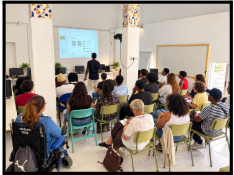 Participants followed the demonstration and then explored the app on their own phones.
The game performed well as a curiosity trigger, although the evaluation also showed that the bridge from curiosity to independent vocabulary learning can be strengthened, for example through instant meanings, pronunciation, audio or a save-for-later function.
Direct user feedback for the final improvement cycle
The Tenerife workshop forms part of the final D4.7 testing phase of PIPE. The evidence gathered will feed into the Spanish national report and the consortium’s final recommendations, with particular attention to multilingual stability, performance, audio accessibility and the connection between interactive vocabulary activities and autonomous learning.
The PIPE Migrant Guide brings together practical information on healthcare, housing, employment, language and education, rights and procedures, and community life. Its aim is simple but ambitious: to make reliable information easier to reach at the moment when someone who has just arrived needs it most.
What the workshop tells us
1. Users value the content and find it relevant to their real lives.
2. Good facilitation helps people use the app on their own.
3. Technical reliability across languages is essential.
4. Audio and read-aloud functions can open the app to many more users.
5. Real user testing turns a digital product into a better inclusion tool.